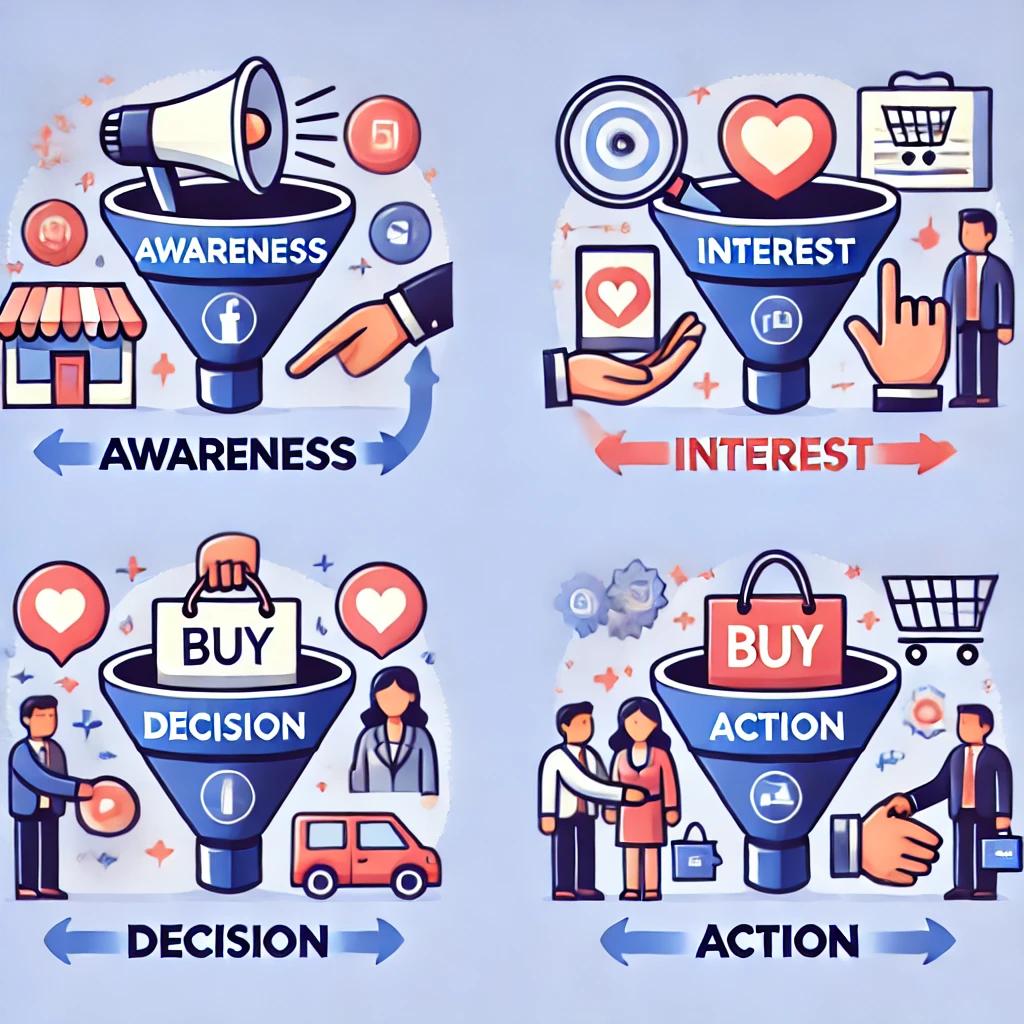
Today, let's talk about a story on how to attract customers and eventually make them place order. The key players in this story are the "Marketing Funnel". These terms may sound complicated, but they’re actually as simple as playing a game on the playground.
One day, Mike decided to open an ice cream shop, selling delicious and affordable ice cream. However, there was a problem: no one knew about his shop. So, Mike needed a way to attract more people to visit. This is where the marketing funnel comes into play.
Think of the marketing funnel as a guide that helps Mike lead potential customers step-by-step to his ice cream shop until they finally decide to make a purchase. The funnel has several important stages, just like levels in a game. Let’s look at them one by one.
Mike’s first task was to let people know his ice cream shop existed. So, he put up a big sign near the school that said, “Mike’s Ice Cream is Delicious and Affordable, Come Try It!” This is like blowing a whistle on the playground to get everyone’s attention and let them know there’s tasty ice cream available. This is the first stage of the marketing funnel: Creating Awareness.
Mike could also use digital marketing methods, such as posting on social media or asking friends to share his ads online. This way, even more people would see his message through the internet.
Next, Mike needed to make sure that people who saw his ad became interested. Imagine you see a sign offering free samples of ice cream; wouldn’t you want to try it? Mike set up a small table outside his shop, giving away free samples to passersby. This little gesture was meant to pique their interest.
In digital marketing, Mike could do something similar by creating an online event where people could get a coupon for a free ice cream if they share his post. This is what we call Generating Interest.
Once people were interested in Mike’s ice cream, the next step was to encourage them to decide to buy. Mike came up with a clever “Buy One, Get One Free” offer, which made people think, “This is a great deal, I should buy one!” This is the third stage of the marketing funnel: Decision.
In digital marketing, Mike could send a special offer through email or show an online ad with a discount to motivate customers to make a decision and purchase.
Finally, people decided to buy the ice cream, and this is the last step of the funnel: Action. Customers left the shop happily enjoying their ice cream, and Mike successfully made a sale.
In the world of digital marketing, the “Action” might be a customer clicking the “Buy” button on a website and completing an online order.

The story doesn’t end there. If customers enjoyed Mike’s ice cream, they might tell their friends about it. Mike also gave them a discount coupon for their next purchase, hoping they would come back. This is how Mike started building customer loyalty.
Similarly, in digital marketing, Mike could send thank-you emails or offer exclusive deals to keep customers coming back. He could also encourage happy customers to share their positive experiences on social media, bringing in even more new customers.
To better understand how the marketing funnel works, let’s use a simple chart:
Through this simple breakdown, we see that while many people noticed Mike’s ad, fewer went on to buy the ice cream. This process is like a funnel: it starts wide at the top and narrows down as you move to the bottom. However, this doesn’t mean failure; it’s a normal part of the customer journey.
The marketing funnel and digital marketing are not as mysterious as they might seem. They are like a game with rules and strategies. Mike successfully attracted customers by creating awareness, generating interest, helping them make a decision, and finally leading them to take action by buying ice cream.
So, the next time you hear about a “marketing funnel,” don’t be intimidated. It’s just a step-by-step journey that guides customers to make a purchase. Hopefully, this story helps you understand how marketing funnels and digital marketing work, and maybe you can use this knowledge in your own projects!