



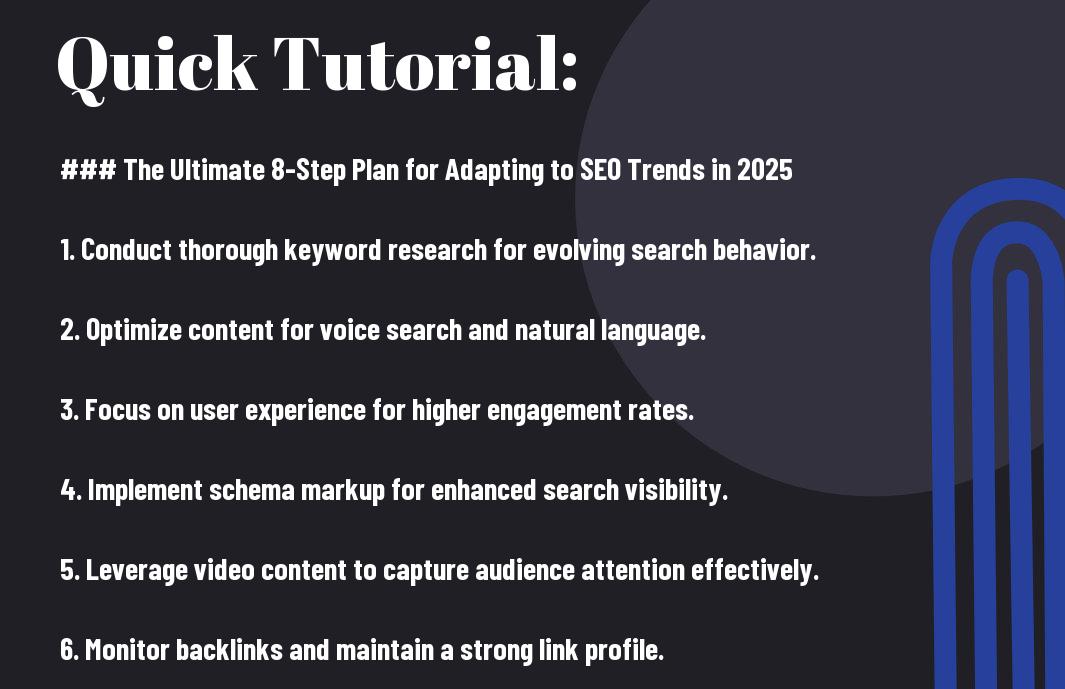
As the digital landscape evolves, it’s imperative that you navigate these changes with astuteness. The year 2025 will bring significant transformations in Search Engine Optimization (SEO) that can greatly impact your online presence and business performance. In this tutorial, you will discover the ultimate 8-step plan crucial for staying ahead of the curve. By implementing these strategies, you can ensure that your content remains not only relevant but also optimized to attract and engage your target audience effectively.
Key Takeaways:
- Focus on user experience and engagement metrics as search engines increasingly prioritize quality content and site performance.
- Embrace the integration of artificial intelligence and machine learning tools to enhance content creation and keyword optimization strategies.
- Stay informed about voice search and mobile optimization trends to ensure your website remains accessible and relevant to users across various devices.

Understanding SEO Trends
Before entering into the specifics, it’s vital to grasp how search engine optimization (SEO) continuously evolves. By understanding the trends shaping your industry, you can effectively position your website to meet the changing demands of search engines and user intent. This proactive approach is vital for sustained online visibility and success in 2025.
Key Trends Shaping SEO in 2025
Clearly, the focus on user experience, voice search optimization, and AI-driven content strategies will dominate the SEO landscape in 2025. Adapting your techniques to these developments ensures that your website remains relevant and easily discoverable in an increasingly competitive digital environment.
The Importance of Staying Ahead of the Curve
One of the most effective strategies you can adopt is to stay ahead of the curve in SEO practices. By consistently monitoring emerging trends, you position your site to capture traffic before your competitors do, leading to better engagement and higher conversions.
Curve your habits by integrating ongoing research into your routine to identify shifts in search algorithms and user behavior. Failing to do so can result in lost visibility and missed opportunities, jeopardizing your site’s performance. Conversely, by embracing innovation and adapting swiftly, you enhance your site’s authority, improve your rank on search engines, and ultimately drive more targeted traffic to your business.
Setting Your SEO Goals
If you want to successfully navigate the evolving landscape of SEO in 2025, setting clear and actionable goals is key. By defining your objectives upfront, you can create a roadmap that not only guides your efforts but also helps you measure your progress and success. Your SEO goals should reflect your business priorities and keep you focused amidst changing trends.
Identifying Target Metrics
To effectively track your SEO performance, you need to identify target metrics that align with your goals. Consider key performance indicators such as organic traffic, keyword rankings, conversion rates, and bounce rates, as these will provide valuable insights into your strategy’s effectiveness and help you make informed adjustments.
Aligning Goals with Business Objectives
The best SEO strategies are those that align with your business objectives. By ensuring your SEO goals support your broader business aims, such as increasing revenue or expanding your audience, you can create synergy across departments and enhance overall performance.
Goals that are aligned with your business objectives can lead to enhanced brand visibility, stronger customer engagement, and ultimately, increased revenue generation. When your SEO initiatives aim to solve real business problems or capture new opportunities, you will see more meaningful, impactful results from your efforts. Taking a holistic approach ensures you use SEO as a powerful tool to drive business growth and adapt to the latest trends effectively.

Conducting Comprehensive Keyword Research
All successful SEO strategies start with comprehensive keyword research. This process involves identifying the terms and phrases your target audience uses when searching for products or services like yours. By understanding these keywords, you can optimize your content effectively, ensuring it ranks higher in search engine results and attracts motivated visitors who are ready to convert.
Tools and Techniques for Effective Research
Researching keywords effectively requires a mix of tools and techniques that can reveal valuable insights. Utilize platforms like Google Keyword Planner, SEMrush, and Ahrefs to discover keyword volumes, competition, and trends. Additionally, pay attention to long-tail keywords, as they often have less competition and can yield higher conversion rates. Implementing these strategies will help you build a robust keyword list tailored to your audience’s needs.
Analyzing Competitor Keywords
Even if you have strong keywords in mind, analyzing competitor keywords can provide you with a significant edge. By examining which keywords your competitors are targeting successfully, you can uncover new opportunities and gaps in your own strategy.
Tools such as SpyFu and BuzzSumo can help you identify the keywords that drive traffic to your competitors’ websites. Focus on high-ranking keywords that correlate with your offerings, but do not limit yourself to their strategies. By understanding their keyword journey, you can harness positive insights and identify dangerous pitfalls to avoid, allowing you to refine your keyword approach and enhance your visibility effectively.
Optimizing On-Page Elements
After understanding the significance of on-page optimization, it’s time to fine-tune your website’s elements. This involves enhancing various components, such as content structure, headings, and multimedia, to align with current SEO best practices. By focusing on these elements, you can improve your overall user experience and search engine ranking, which is necessary for visibility in a competitive digital landscape.
Crafting SEO-Friendly Content
If you want to ensure your content ranks well, it should be engaging, relevant, and optimized with target keywords. This means incorporating your chosen keywords naturally throughout the text while also addressing your audience’s needs and interests. Strive to provide real value to your readers, positioning your content as a go-to resource in your niche.
Enhancing Meta Tags and Descriptions
Tags play a significant role in your website’s SEO. You should craft compelling title tags and meta descriptions that not only include your target keywords but also encourage users to click through from search results. Strong title tags can improve your visibility on SERPs, while a captivating meta description can increase your click-through rate.
A well-optimized title tag should be concise, ideally around 60 characters, and incorporate your primary keyword at the beginning. Additionally, the meta description should not exceed 160 characters, offering a brief summary of the content that entices users to click. Overlooking these elements can lead to missed opportunities in attracting organic traffic, which is vital for increasing your site’s overall performance.
Leveraging Technical SEO
Keep up with the rapid evolution of SEO by effectively leveraging technical SEO. This involves ensuring your website’s infrastructure is optimized for search engine performance, enabling better visibility and usability for your audience. From site speed to crawlability, focusing on technical aspects will empower you to adapt to changes and enhance your overall search engine strategy.
Importance of Site Speed and Mobile Optimization
With the majority of users accessing content via mobile devices, site speed and mobile optimization are indispensable for retaining visitors and improving rankings. A fast, responsive website not only provides a better user experience but also signals to search engines that your site is well-maintained and worth prioritizing in search results.
Addressing Crawlability and Indexing Issues
Site performance can suffer when crawlability and indexing issues are left unresolved. Search engines need to effectively access and categorize your content to rank it accurately. If your pages are blocked by robots.txt or if there are broken links, it can drastically limit your visibility.
For instance, a well-structured XML sitemap can facilitate the indexing process, ensuring search engines discover new pages promptly. Conversely, a flawed site architecture can confuse search bots, resulting in missed opportunities as your content remains unindexed. Regularly auditing your site for crawl errors and ensuring all important pages are accessible can significantly improve your site’s performance and visibility, keeping you ahead of the competition.
Building Quality Backlinks
Once again, enhancing your SEO strategy in 2025 requires you to focus on building quality backlinks. By prioritizing high-authority sources, you can improve your site’s credibility and search visibility. To guide you on this journey, check out 2025 SEO Trends and Strategies for Enterprises.
Strategies for Effective Link Building
If you want to excel in your link-building efforts, consider leveraging content marketing, guest blogging, and outreach campaigns aimed at relevant influencers in your industry. Creating valuable content that others want to link to fosters organic backlinks, expanding your reach and authority.
The Role of Authority and Trustworthiness
The importance of authority and trustworthiness in link building cannot be overstated. Your backlinks come from reputable sources, which significantly impacts your website’s ranking. Quality over quantity is key; having fewer but high-quality links from trusted sites enhances your profile, while low-quality links may lead to penalties.
Trustworthiness is central to effective link building. When your backlinks originate from reputable sources, it strengthens your site’s credibility. Remember that links from sites with a strong reputation can elevate your own authority and contribute positively to your SEO. On the other hand, links from questionable sources can harm your rankings and jeopardize your online reputation. Be diligent in ensuring that your link-building practices align with best practices to create a trustworthy online presence.
Conclusion
Hence, by following this 8-step plan, you can effectively adapt to the ever-evolving SEO landscape of 2025. Staying informed about emerging trends, leveraging advanced tools, and focusing on user experience will empower you to enhance your online presence. As you refine your strategies, continuously analyze your performance and make data-driven adjustments to stay ahead. Your commitment to adapting will solidify your position in a competitive digital marketplace, ensuring your success for years to come.
FAQ
Q: What are the key components of the 8-step plan for adapting to SEO trends in 2025?
A: The 8-step plan encompasses a comprehensive approach that includes the following components: 1) Conducting thorough market and keyword research to identify emerging trends, 2) Optimizing for voice search and AI-driven queries, 3) Enhancing mobile usability to cater to the growing percentage of mobile users, 4) Focusing on user experience (UX) as a ranking factor, 5) Creating high-quality and engaging content that addresses users’ needs, 6) Building a strong backlink profile, 7) Leveraging local SEO strategies, and 8) Analyzing performance metrics regularly to adapt strategies as needed. Each of these steps helps businesses align their SEO practices with future industry developments.
Q: Why is it important to focus on user experience as part of the SEO strategy for 2025?
A: User experience plays a significant role in determining website rankings, as search engines are increasingly prioritizing sites that provide a seamless and enjoyable user interface. High bounce rates, slow page load times, and complicated navigation can negatively affect a site’s visibility in search results. By investing in UX, businesses can not only improve their SEO but also boost engagement and conversion rates. Prioritizing user experience helps create a loyal customer base and fosters positive word-of-mouth referrals, imperative for long-term success.
Q: How can businesses stay updated with the rapidly changing SEO trends leading up to 2025?
A: To remain informed about the evolving landscape of SEO, businesses should regularly follow reputable SEO blogs, attend industry conferences, and participate in webinars. Networking with other marketing professionals and joining relevant forums can provide insightful discussions regarding the latest trends. Additionally, subscribing to newsletters from thought leaders and monitoring search engine algorithm updates can equip businesses with timely information. Continuous learning and adapting strategies based on new insights will help ensure that a business remains competitive in its SEO efforts.